Workshop with Hee Gun Kim
4-day immersion in Korean Onggi pottery with master Hee Gun Kim
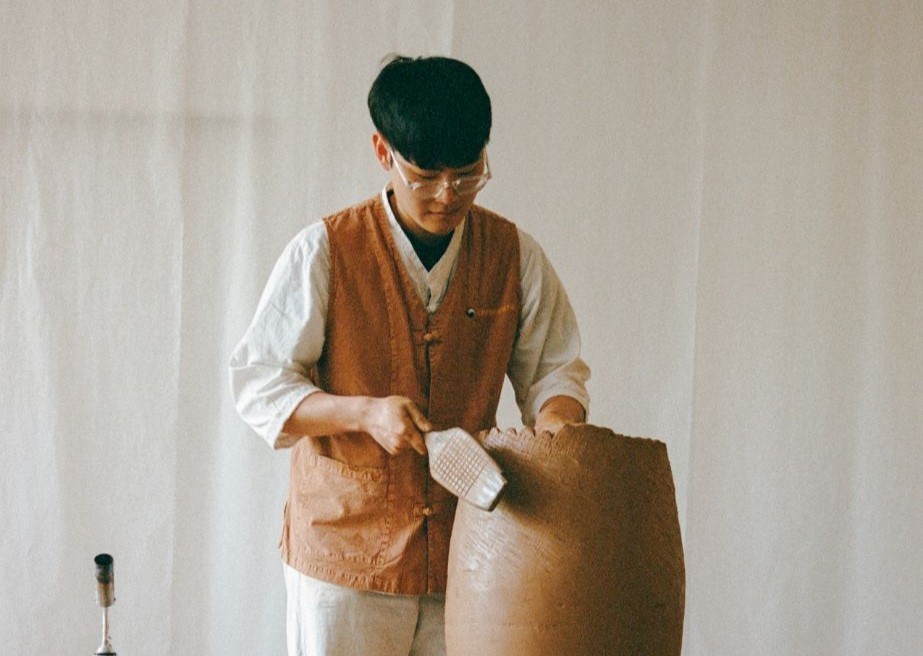
During this 4-day masterclass, participants will explore the full spectrum of Onggi-making techniques, including clay preparation; stretching the clay into coils (taryeom); building the base (ba-dak); raising the walls (taryeom-jil); paddling (surae-jil); shaping with metal ribs; and forming the rim.
This immersive masterclass focuses on large-scale work and traditional Korean Onggi techniques.
The masterclass is open to participants of all skill levels, from beginners to advanced ceramists. While the core programme is accessible to everyone, personalised one-to-one guidance will be provided throughout the course, tailored to each participant’s level and goals.
The day prior to the masterclass, Hee Gun Kim will present an interactive performance on 8 February, introducing the world of Onggi, fermentation, and live making.
General Information
Schedule: 09–12.02, 10:00–17:00
Language: English
Age: 15+
Capacity: 12 participants
Detailed Programme
— Introduction by Hee Gun Kim and course overview
— Presentation: History of Onggi, Onggi masters, and regional characteristics (including historical audiovisual material)
— Demonstration: Traditional Onggi making (creation of a 60 cm jar)
— Practice: Building the base and preparing clay coils
— Learning the Onggi taryeom technique
Mission: Build a straight wall up to 40 cm using the taryeom technique
— Learning the Onggi techniques surae-jil and geungae-jil
Mission: Create a straight 45 cm cylinder using the taryeom, surae-jil, and geungae-jil techniques
— Begin construction of a traditional 60 cm Onggi (Part 1)
— Practice: 60 cm jar (Session 1)
— Demonstration of traditional Onggi forms used historically in Korea
— Individual feedback (one-to-one)
— Completion of the traditional 60 cm Onggi (Part 2)
— Group project with workshop participants (to be defined and discussed during the course)
— Closing remarks and group photo
During the workshop, participants will have the opportunity to purchase an exclusive set of 8 Onggi tools, handcrafted by a Korean artisan using traditional methods. Each set includes: 5 wooden tools, 2 metal ribs, and 1 shammy tool. Price: €180. Only 12 sets will be available. We recommend letting us know in advance if you wish to purchase a set. For reservations and further information, please contact: [email protected]
You are welcome to keep the pot(s) you make. However, they must be fired and collected at another location in Lisbon. Firing is charged separately and takes about one month to complete the two firings (we have limited space for large pots). Most students use the course to learn and experiment, so many pieces may be sacrificial – but this is entirely up to you. Please note that the pots will be extremely heavy and difficult to move.
About the Onggi technique
Onggi are traditional Korean vessels used during the Joseon period to store fermented foods such as kimchi, doenjang (soybean paste), soy sauce, and gochujang (red chili paste). Many everyday household items were also made from Onggi. However, due to changes in lifestyles and materials, the use of Onggi has declined sharply and is now at risk of disappearing. From a young age, Hee Gun Kim has been aware of this situation and has reflected on ways to reintroduce this valuable cultural heritage into contemporary society.
The Onggi-making technique is unique worldwide, allowing a single person to construct large-scale vessels in a short period of time. This method can be applied not only to traditional Onggi, but also to clay sculpture and large-scale hand-building in contemporary ceramics and art.
Unlike conventional pottery, which is largely hand-centred, Onggi making relies on a wide range of tools, helping participants develop both material sensitivity and technical tool-handling skills. Learning Onggi is therefore not only about making vessels, but also about gaining insight into Korean food culture and the aesthetics of everyday life.
About Hee Gun Kim
Hee Gun Kim is a descendant of a family that has practised traditional Korean Onggi pottery in South Korea for eight generations. His family has been producing Onggi since the persecution of Catholics in the late Joseon period, maintaining this lineage continuously to the present day. His grandfather is a holder of the National Intangible Cultural Property for Onggi, and his father is a holder of the Gyeonggi-do Intangible Cultural Property for Onggi.
In contact with this tradition from an early age, Kim developed an ongoing relationship with Onggi, integrating its technical knowledge, materials, and production processes through direct transmission.
After completing his military service, he further deepened his training in traditional Onggi, committing to this practice as a long-term path centred on technical dedication and the continuation of this tradition within a contemporary context.
About Ceramic Studio
Carole Luel is the founder of Ceramic Studio, a platform dedicated to practice, education, and exchange in the field of contemporary ceramics. Originally established in Belgium, Ceramic Studio is now based in Lisbon. Over recent years, it has become a recognised space for experimentation, learning, and encounter around ceramics.
Conceived as an open and inclusive space, Ceramic Studio fosters a collaborative working environment focused on knowledge transmission, technical development, and the appreciation of making by hand. Its activity is grounded in creating contexts of exchange between practitioners with diverse backgrounds and levels of experience.
Throughout its trajectory, Ceramic Studio has hosted internationally recognised ceramicists, organising workshops and residencies that function as platforms for technical and artistic exchange.
In Portugal, Carole Luel is currently developing a programme centred on building an active ceramics community, with a focus on the exploration of specialised techniques and collaboration with Portuguese and international ceramicists.